For generations of baseball-card collectors, the start of Hank Aaron’s profession has been represented by one unmistakable picture: his 1954 Topps #128. The orange background, the younger Milwaukee Braves Outfield, the smaller fielding put up and the facsimile signature have turn into a part of the visible language of postwar baseball. It’s a kind of playing cards a collector can acknowledge from throughout a room. The 1954 Topps #128 is Hank Aaron’s rookie card, however it’s not his earliest card (1).
Determine 1. 1954 Topps #128 Henry Aaron, Hank Aaron’s rookie card.
Two years earlier than that well-known Topps situation – earlier than Milwaukee, earlier than quantity 44, earlier than 715, earlier than Cooperstown – one other card pictured an 18-year-old Henry Aaron within the uniform of the Indianapolis Clowns. Virtually nobody is aware of it exists.
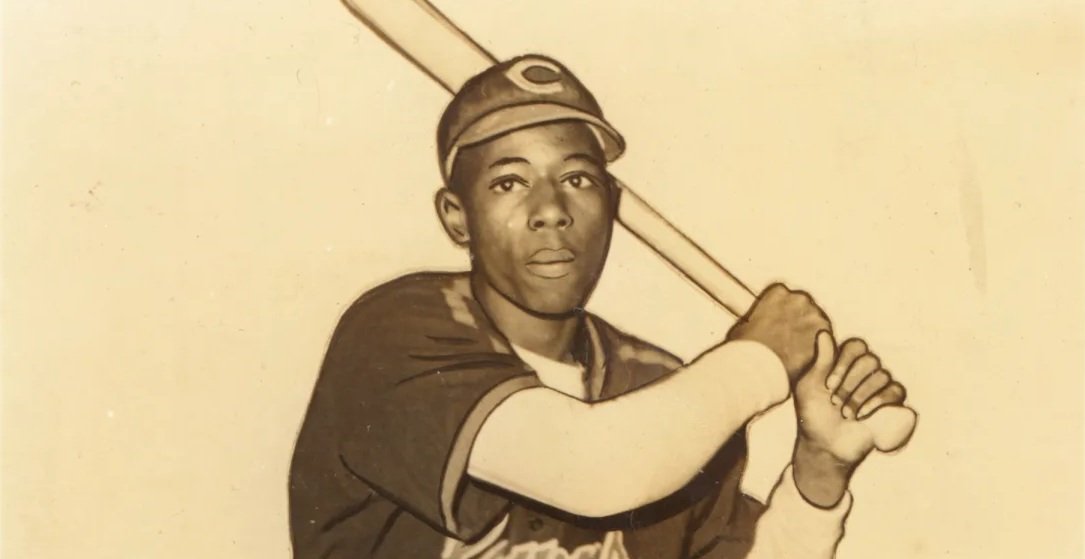
The 1952 J.J.Ok. postcard is strikingly spare. Aaron stands alone with a bat resting behind his head, sporting the darkish Clowns uniform and cap. There are not any statistics, no biography and no printed identify to inform a collector who this teenager is. The reverse carries solely the language of a photographic postcard and the imprint of J.J.Ok. Copy-Artwork Photographers in New York Metropolis. J.J.Ok. Copy-Artwork was operated by famous New York photographer James J. Kriegsmann and was recognized for its work with entertainers and Black performers. It’s the similar J.J.Ok. related to the better-known 1950 J.J.Ok. Jackie Robinson postcard (2).

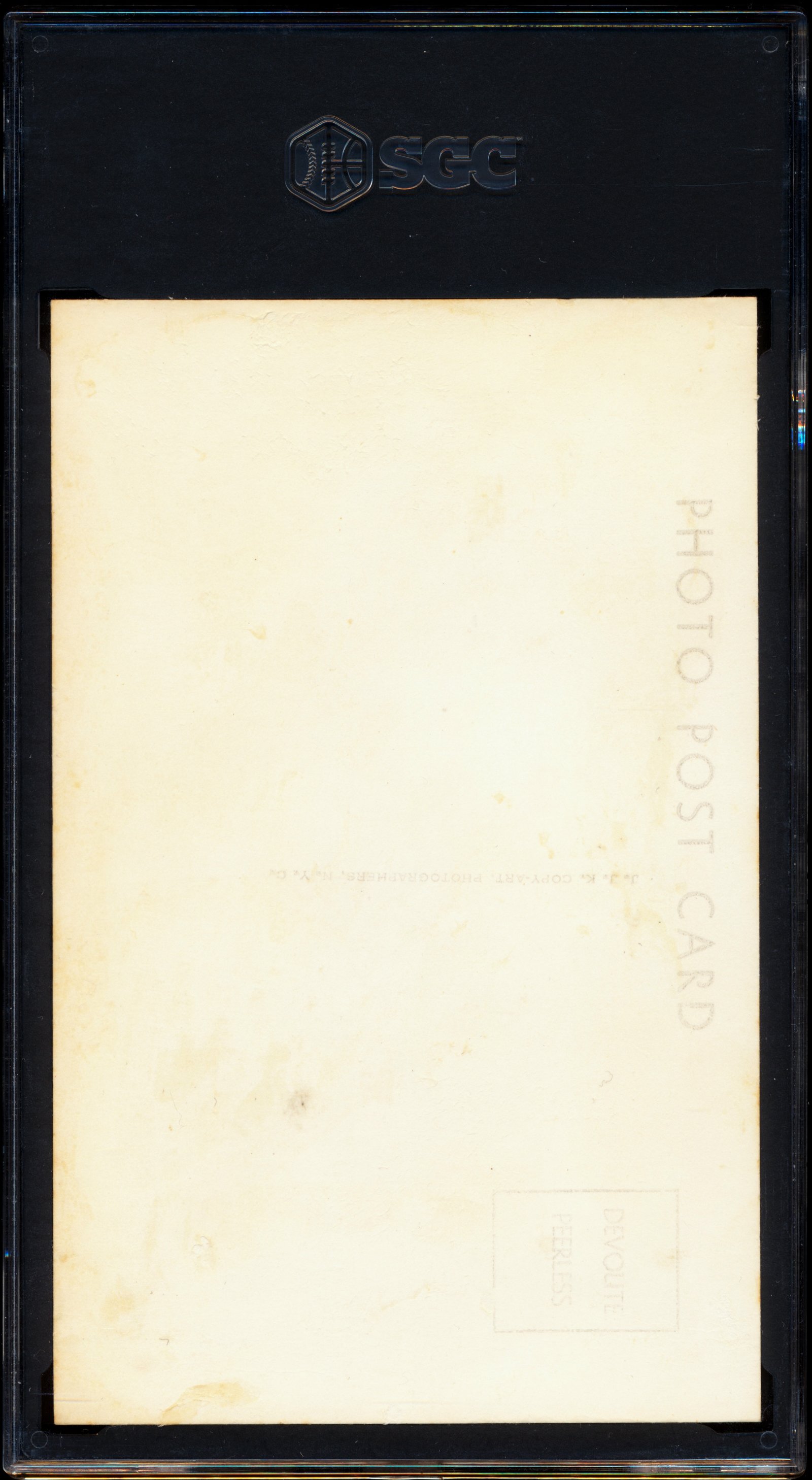
Determine 2A-B. 1952 J.J.Ok. Henry Aaron postcard, entrance and reverse. This instance descended from the gathering of Ed Scott, supervisor of the Cell Black Bears and a scout for the Indianapolis Clowns.
Solely two examples are presently recognized. But rarity alone shouldn’t be what makes the postcard extraordinary. What units it aside is the paper path round it. Letters, images, scouting experiences, newspaper clippings, a surviving printing minimize and the provenance of the 2 recognized postcards enable us to look at Aaron’s first skilled season unfold nearly week by week. The postcard doesn’t commemorate Henry Aaron’s profession with the Indianapolis Clowns. It documented that profession at its very starting.
Aaron’s baseball story started in Cell, Alabama, and Ed Scott was there nearly from the beginning. Scott managed the Cell Black Bears, Aaron’s first workforce, and likewise scouted for the Indianapolis Clowns. He noticed {the teenager} earlier than the remainder of skilled baseball did, labored carefully with Aaron and his household, and helped flip native promise into a possibility past Cell (3). That relationship issues as a result of one of many two presently recognized J.J.Ok. postcards would stay with Scott for greater than seventy years.
By November 1951, the following step was already taking form. Aaron accomplished an Indianapolis Clowns participant questionnaire dated November 13. He recognized the Cell Black Bears as his earlier workforce, listed shortstop and second base as his positions, and requested for a month-to-month wage of $250 (4). It’s a humble doc – a teenage ballplayer filling in a type – however on reflection it’s tough to not linger over it. The handwriting belongs to Henry Aaron earlier than the baseball world knew what that identify would imply.

Determine 3. Henry Aaron’s full Indianapolis Clowns participant questionnaire, dated November 13, 1951. Aaron listed the Cell Black Bears as his earlier workforce and shortstop/second base as his positions.
Aaron and the Clowns finally agreed to phrases of $200 per thirty days. On March 24, 1952, Aaron wrote Clowns proprietor Syd Pollock that he was ready for his ticket and anticipated to succeed in camp on the morning of April 10 (5). Aaron arrived as deliberate on April 10, 1952.
The departure from Cell survives in three images taken by Ed Scott. Scott later recalled driving Aaron to the station, photographing him earlier than departure and standing on the platform because the prepare pulled away. One picture reveals Aaron standing on the platform beside the prepare together with his bag at his ft. One other reveals him posed within the doorway of the automotive. In a 3rd, he raises a hand in farewell from the prepare. They’re quiet images, however understanding what got here afterward offers them huge weight. The pictures should not of the established home-run king leaving for one more highway journey. They’re of an 18-year-old leaving residence at first of a journey that may carry him farther than anybody at that station might have imagined (27).

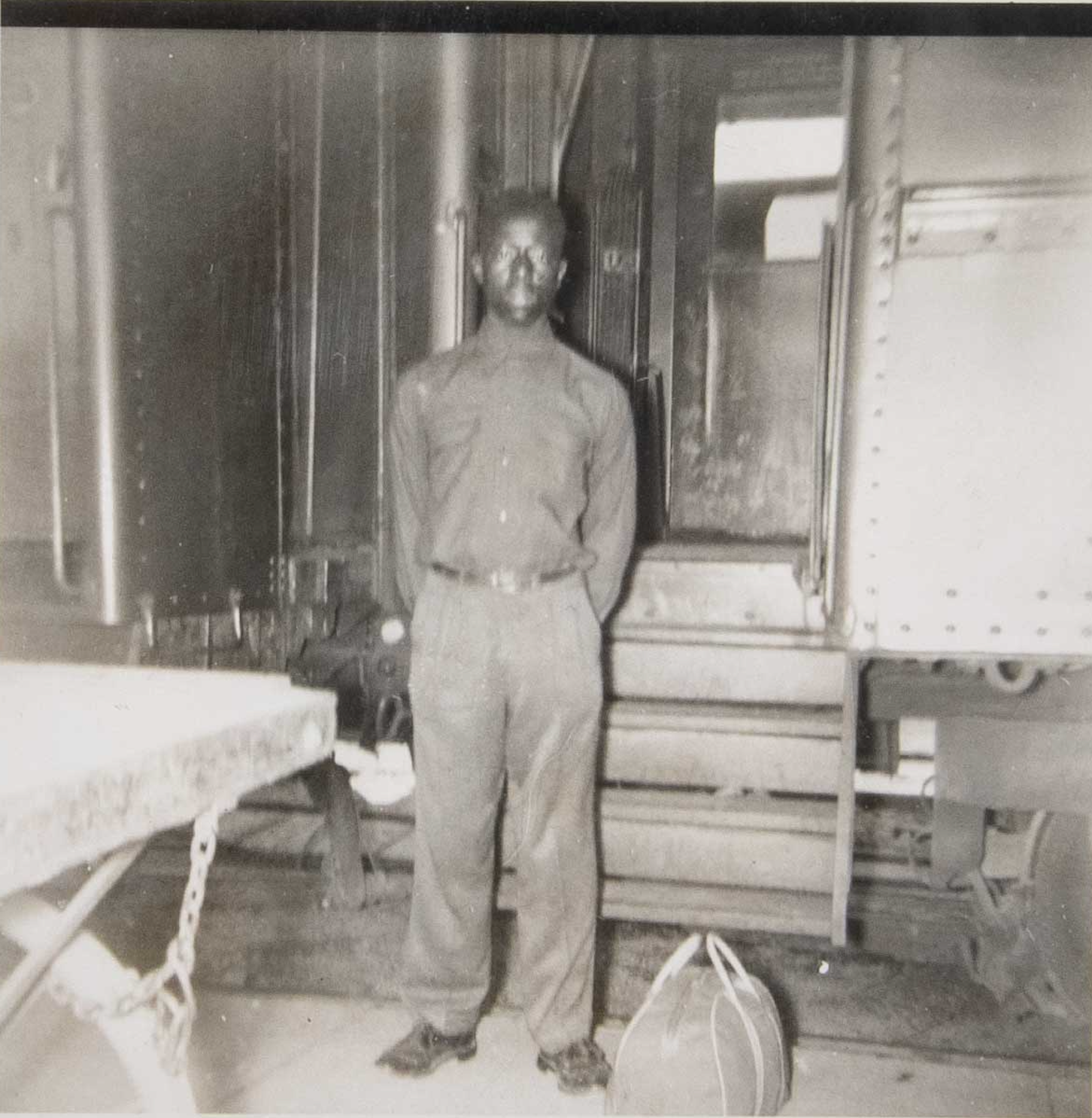
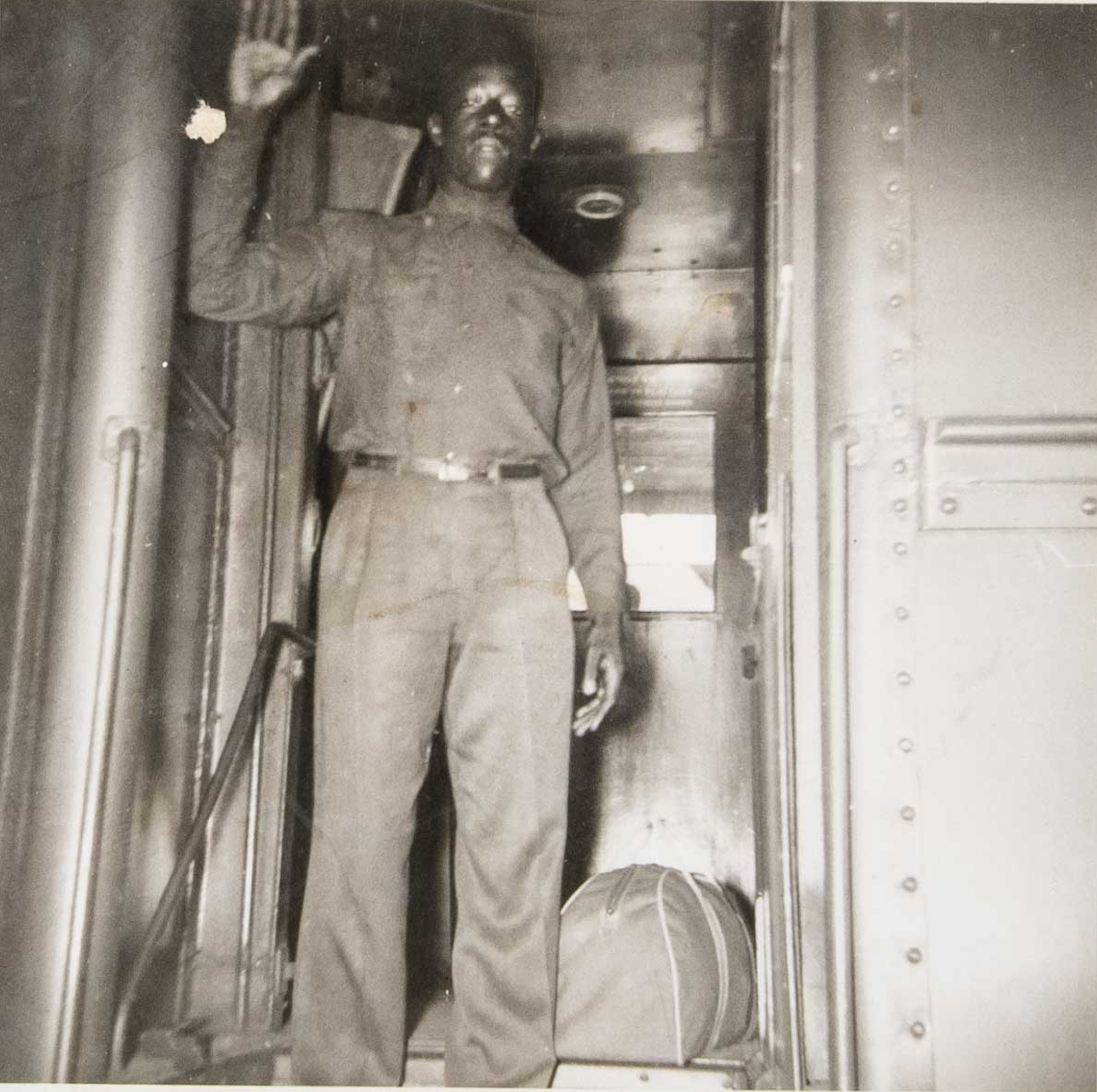
Determine 4A-C. Henry Aaron leaving Cell to hitch the Indianapolis Clowns, April 1952. Images by Ed Scott, who drove Aaron to the station and preserved the pictures documenting his departure.
Aaron’s first weeks with Indianapolis justified Scott’s religion nearly instantly. Earlier than the Negro American League (NAL) season started, Aaron was already making a reputation for himself. On April 16 in Charlotte, he singled, doubled and tripled in opposition to the Philadelphia Stars. By late April, experiences credited him with a .350 common and three triples and known as his hitting and fielding ‘a revelation.’ Clowns supervisor Buster Haywood known as him a ‘nice discover (6).
By Could 10, the Huntsville Mirror had discovered the phrase that finest captured Aaron’s first month: the 18-year-old was ‘the feeling of the spring exhibition contests.’ He had not but performed a single Negro American League regular-season sport; the league’s common season would open on Could 11 (7).
That very same day, Could 10, Pollock wrote Ed Scott from New York. The letter is the hinge on which the story of the J.J.Ok. postcard turns. Pollock advised Scott that experiences from Haywood and Clowns enterprise supervisor Bunny Downs had satisfied him Aaron would stick with the membership. Downs had additionally evaluated Aaron in Cell in 1951, giving {the teenager} a pregame tryout and sending Pollock a good report. Pollock enclosed $50 for Scott’s assist in signing Aaron, then defined what he supposed to do subsequent (28).

Determine 5. Syd Pollock to Ed Scott, Could 10, 1952. Pollock wrote that he was having newspaper cuts and images fabricated from Aaron to attract scouts’ consideration and ‘construct up his identify all through the nation.’
“I get newspaper cuts and photographs made up on him … in an effort to attract scouts consideration to him, and construct up his identify all through the nation.”
The timing is nearly startling. Pollock was not reacting to a longtime Negro American League star. He was making an attempt to create nationwide consideration round a teen who had been with the Clowns for under a month and had but to play a league sport. Pollock understood the chance: if Aaron was nearly as good because the experiences mentioned, publicity might assist place him in entrance of MLB scouts. The newspaper cuts and images had been just one a part of that effort. In accordance with Syd Pollock’s son, Alan Pollock, Syd had already known as the younger shortstop to Braves govt John Mullen’s consideration, and when an preliminary scouting report proved unfavorable, Pollock pressed Boston to take one other look. The Negro American League common season started on Could 11, and Aaron now had the chance to show that his outstanding spring was solely the start (29).
Aaron then made Pollock’s gamble look much less like promotion and extra like prophecy. By means of Could 25, Aaron was credited with hitting .483 – 28 hits in 58 at-bats – with six doubles, 5 residence runs, 24 RBIs and 51 whole bases (9). He led the league in each a kind of classes, a unprecedented measure of simply how a lot the 18-year-old was dominating the competitors. {The teenager} who had been a spring sensation was now overwhelming league pitching.
On Could 25, Boston Braves scout Dewey Griggs watched Indianapolis play Memphis in a doubleheader at Buffalo. Aaron might hardly have offered a greater audition: Alan Pollock’s account credit him with going seven-for-nine throughout the 2 video games (30). Griggs described Aaron’s hitting, bunting, fielding and throwing in a letter to Braves farm director John Mullen. He was nonetheless making an attempt to find out what Aaron would possibly turn into, however the ultimate thought on the second web page has the facility of hindsight behind it: ‘This boy could possibly be the reply (10).
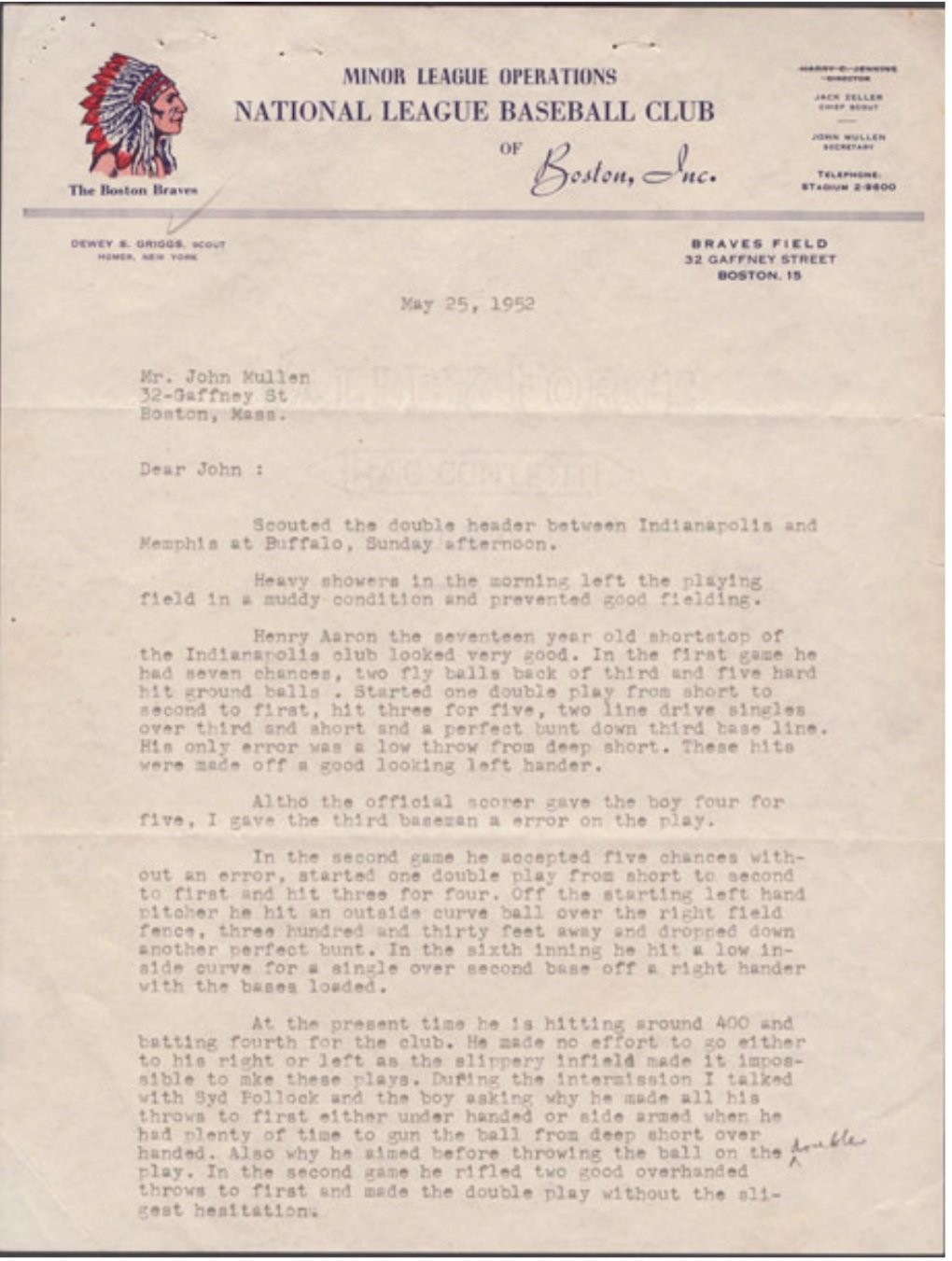
Determine 6A. Dewey Griggs to John Mullen, Could 25, 1952, web page one. Griggs had simply watched Aaron in two video games.

Determine 6B. Dewey Griggs to John Mullen, Could 25, 1952, web page two. Close to the tip, Griggs wrote: ‘This boy could possibly be the reply.’
The road deserves a second. Griggs couldn’t know what readers know now. He couldn’t see 3,771 hits, 755 residence runs, 25 All-Star alternatives or an evening in Atlanta when Aaron would surpass Babe Ruth. He was a uncooked teenager in a Clowns uniform after two video games. But he noticed sufficient to think about an thrilling future.
The subsequent day, Griggs put his judgment into a proper scouting report. Aaron was marked a ‘Particular’ prospect. Griggs praised his ‘nice pair of fingers,’ his relaxed method and his wrist hitting, whereas noting that he wanted expertise and had an inclination to run on his heels. The report is splendidly human: baseball historical past earlier than it had hardened into certainty, with strengths, flaws and prospects typed onto a single sheet of paper (11).

Determine 7. Dewey S. Griggs’s Could 26, 1952 Particular person Participant Report on Henry Aaron. Griggs labeled Aaron as a ‘Particular’ prospect after observing two video games.
On Could 27, Pollock wrote Mullen after a phone dialog and named his value. The bottom deal he would take into account was $10,000, with Aaron to obtain $350 per thirty days. Pollock had already raised Aaron from his authentic $200 wage to $250 per thirty days after seeing him hit; the brand new phrases would elevate him once more (31). Pollock advised the Braves he was asking different golf equipment $15,000 and made his personal audacious comparability: Aaron, he wrote, was ‘one other Ted Williams within the hitting division (12).
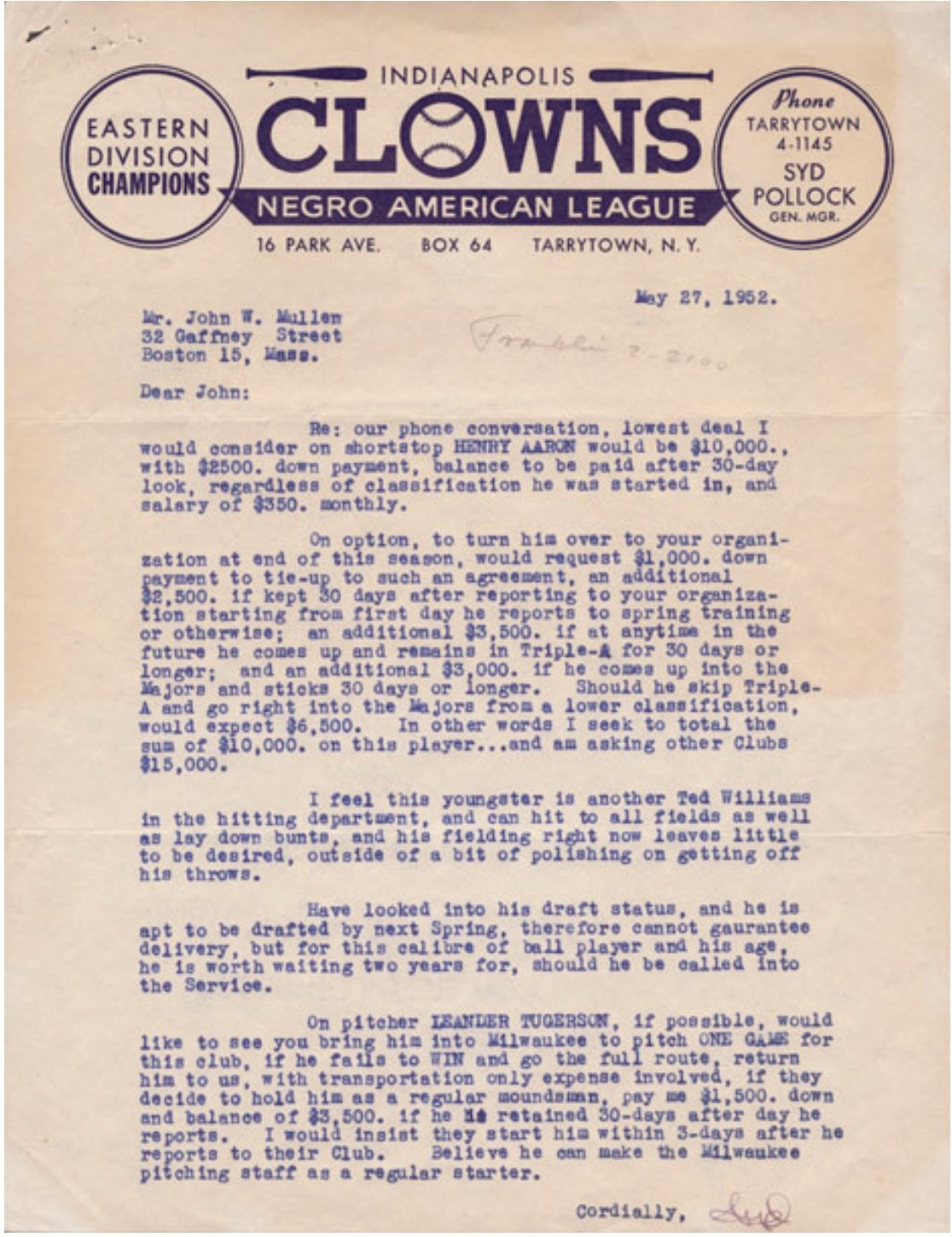
Determine 8. Syd Pollock to Boston Braves farm director John W. Mullen, Could 27, 1952, setting phrases for Henry Aaron’s contract.
The Braves moved shortly, however they weren’t alone. On Could 28, the New York Giants supplied $15,000 for Aaron’s contract, considerably greater than Boston’s $10,000 association. The Giants initially proposed paying Aaron $250 per thirty days – the identical wage he was already receiving from Indianapolis – whereas Pollock insisted on $350. Braves govt John Mullen agreed to the upper wage, and Pollock’s archive contained Could 28 and Could 29 telegrams documenting Boston’s acceptance of the $10,000 settlement and Aaron’s $350 month-to-month pay (13) (32). Lower than three weeks after Pollock advised Scott he wished to attract scouts’ consideration to Aaron, two major-league organizations had been competing for him.
That chronology doesn’t show Pollock’s publicity brought on Griggs to see Aaron. It does one thing extra worthwhile: it lets us watch the 2 tales transfer collectively. Pollock was making an attempt to make the baseball world discover Aaron on the precise second Aaron’s play was making him unattainable to disregard.
On the heart of that publicity was a picture. Somebody drew Aaron in his Clowns uniform, bat resting behind his head. The artist is unknown. The drawing was then photographed or in any other case photographically reproduced, and J.J.Ok. Copy-Artwork Photographers in New York Metropolis used that copy to make the postcard (14). In its easiest type, the manufacturing chain was simply that: drawing to {photograph} to postcard.
A photographic print provided by the Negro Leagues Baseball Museum preserves the identical drawing. On that exact print, somebody later wrote ‘1952’ and ‘Henry “Hank” AARON’ by hand. The date of the bodily print shouldn’t be but recognized, however the picture is invaluable as a result of it reveals the art work as an object in its personal proper – earlier than we comply with it into the newspapers.
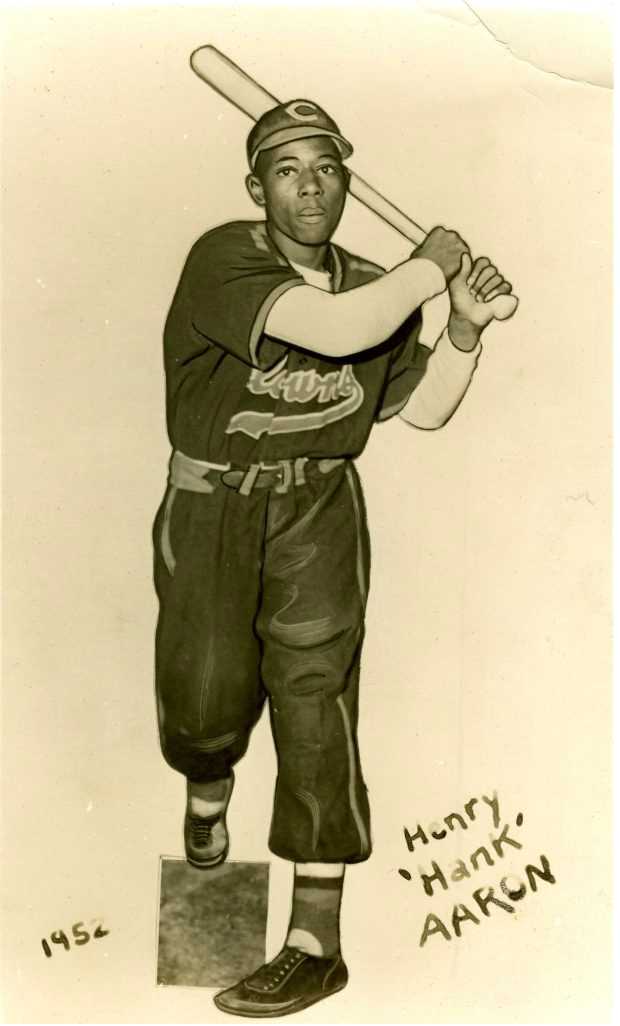
Determine 9. Photographic print reproducing the identical Henry Aaron drawing used on the J.J.Ok. postcard. Courtesy of the Negro Leagues Baseball Museum. The handwritten identification belongs to this print and was not a part of the underlying art work.
The primary newspaper presently documented utilizing the identical picture that seems on the postcard was the June 6, 1952 Herald-Press of St. Joseph, Michigan. The Clowns had been coming to Edgewater Park, and there was Aaron on the left of the commercial – the identical determine seen on the postcard, nonetheless with out the later identification field (15).
At some point later, the Chicago Defender used the identical Aaron determine in a extra elaborate type. Beside him was a hand-lettered panel: Henry Aaron / Flashy / Shortstop / of Clowns (16). A surviving newspaper printing minimize carries that very same ready remedy. That is the place the distinction turns into tangible: the underlying drawing didn’t change; the publicity package deal round it did.


Determine 10A-C. The Aaron picture in three kinds. A: the unlettered determine within the June 6, 1952 Herald-Press. B: the June 7 Chicago Defender model with ‘Henry Aaron / Flashy / Shortstop / of Clowns.’ C: the surviving newspaper minimize carrying the identical lettered remedy. The surviving minimize seems unused and is a bodily instance of the type of minimize Pollock described having made.
The June 6 look is very essential for courting the postcard. The picture used on the J.J.Ok. postcard was already in newspaper circulation by that date, making it seemingly that the postcard had already been created. What is for certain is that it existed by July 4. On that day, Pollock wrote Scott once more and talked about the postcards instantly.
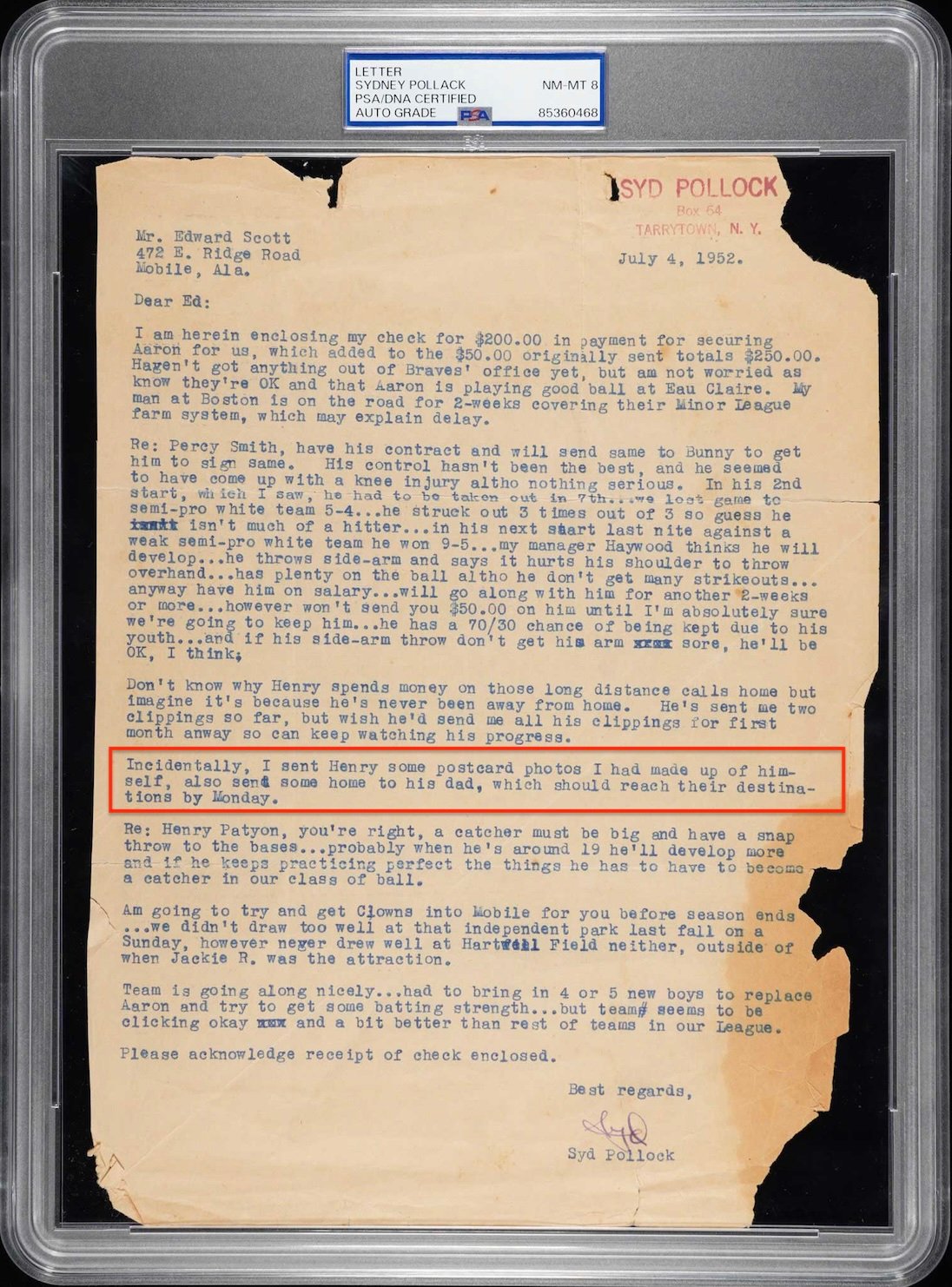
Determine 11. Syd Pollock to Ed Scott, July 4, 1952. Pollock confirmed that he had ‘put up card photographs’ of Aaron made and despatched copies to Aaron and to Aaron’s father.
“I despatched Henry some put up card photographs I had made up of himself, additionally despatched some residence to his dad …”
With that sentence, the postcard strikes from inference to certainty. Pollock had postcard images made; he despatched copies to Aaron; he despatched others residence to Aaron’s father. The cardboard was not a later memento created after Aaron turned well-known. It belonged to the identical summer season during which Pollock was making an attempt to construct his identify, scouts had been evaluating him, and Aaron was leaving the Negro Leagues for the Braves group (17).
The July 4 letter additionally closes one other circle in Aaron’s story. Scott had an settlement with Pollock to obtain a set fee when a participant he advisable was offered to an MLB group. Aaron earned Scott $250 – the $50 beforehand paid and the extra $200 enclosed with the July 4 letter – the most important scouting fee Scott acquired from Pollock (33).
The surviving bodily items match collectively nearly uncannily. The J.J.Ok. postcard, the lettered printing minimize and Ed Scott’s authentic Chicago Defender clipping could be positioned facet by facet and the Aaron determine aligns at almost the identical scale. Measured from foot to move, the postcard and surviving minimize are each 4 9/16 inches; the newspaper copy is barely 3/16 inch bigger (18). {A photograph} from the Pollock assortment reveals three Aaron cuts amongst different Clowns publicity materials, proof that the picture was ready for repeated use fairly than as a one-off curiosity.
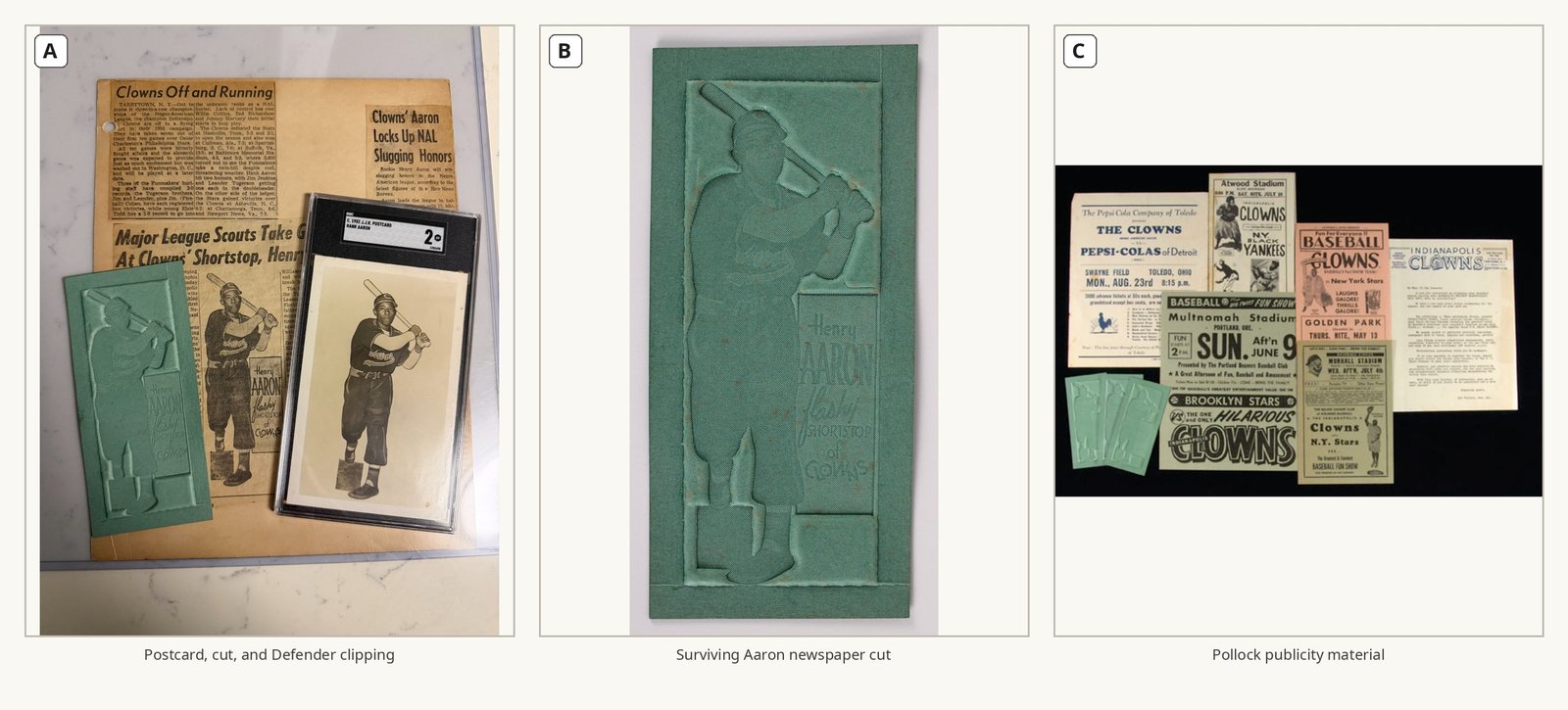
Determine 12A-C. The surviving publicity items collectively: the postcard, Aaron printing minimize, Ed Scott’s authentic Chicago Defender clipping, and Pollock-family publicity materials exhibiting a number of Aaron cuts.
Then the picture started to journey. It appeared in St. Joseph on June 6 and Chicago on June 7. On June 17 it reached Brantford, Ontario. On July 8 it appeared in Aaron’s residence area within the Atlanta Each day World. The St. Louis American used it on August 7 after which reused it one week later, on August 14. On October 7, the Johnson Metropolis Press printed the Aaron determine once more (19).
Seen individually, every clipping is a small surviving newspaper fragment. Seen collectively, they’re one thing extra: a visible report of Aaron’s identify and likeness transferring throughout the baseball map whereas his profession was transferring simply as shortly. Michigan. Chicago. Canada. Atlanta. St. Louis. Tennessee. The identical younger Clowns shortstop, carried from newspaper to newspaper.
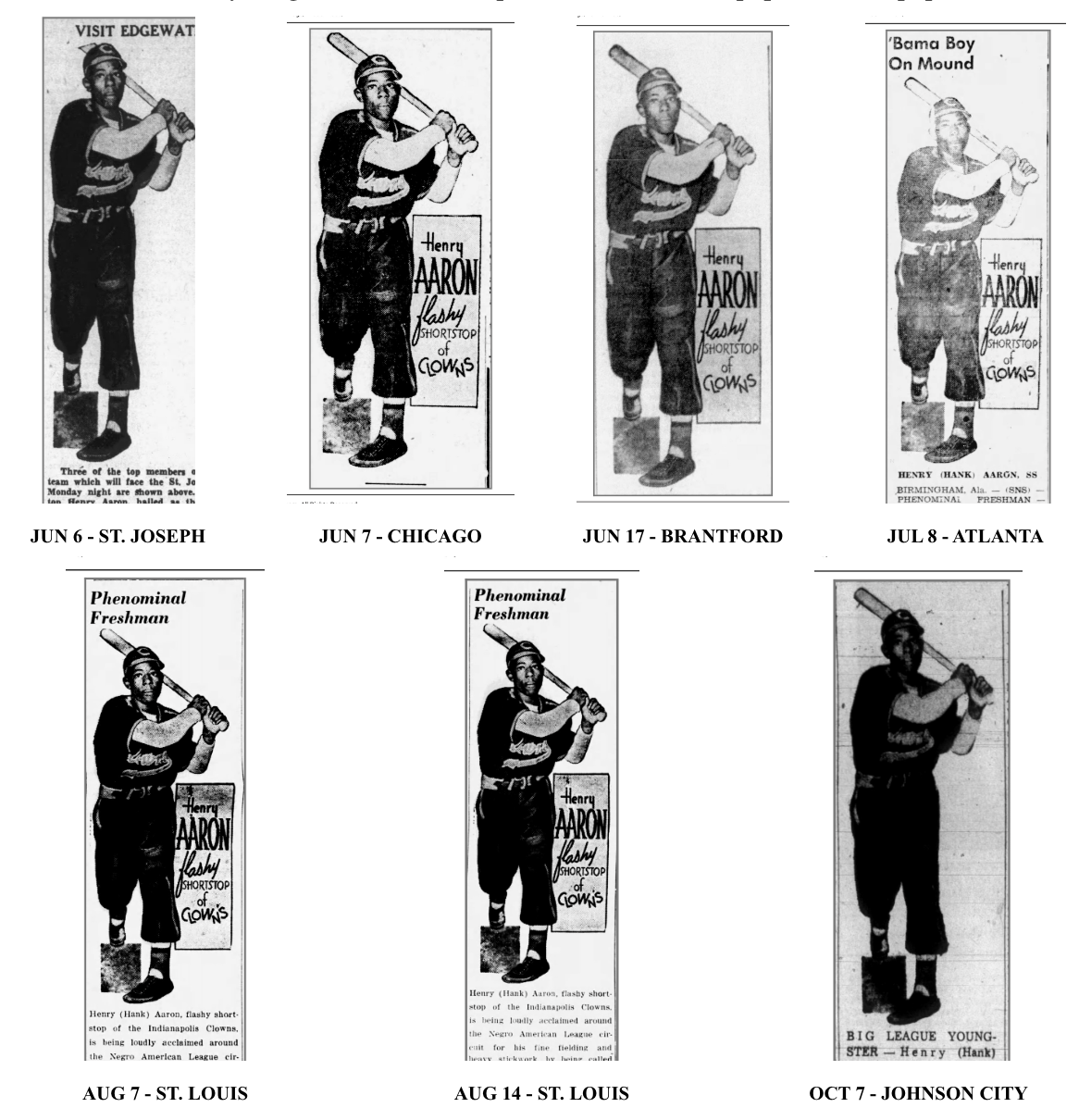 Determine 13A-G. Seven documented newspaper appearances of the Aaron publicity picture in 1952. The St. Louis American reused the picture one week after its August 7 look, demonstrating that the art work functioned as a reusable press asset.
The placements additionally reveal how the picture might serve a couple of goal. Pollock explicitly wrote that he wished to construct Aaron’s identify and appeal to scouts. However the June 6 St. Joseph piece promoted an upcoming Clowns look, and the June 17 Brantford use did the identical. The picture might promote Aaron to the MLB and assist promote the Clowns to the following city on the similar time.
By then Aaron himself had already moved on. He arrived in Eau Claire on June 12 and debuted for the Braves’ Northern League affiliate on June 14 (20). Later June statistical reporting positioned his preliminary Clowns regular-season line at roughly .374, with 5 residence runs and 32 RBIs, whereas main the league in a number of energy classes (21). Aaron’s complete first stick with Indianapolis lasted solely 62 days, from his April 10 arrival by June 11: 31 days of exhibition play earlier than the Negro American League season started on Could 11, adopted by one full month of regular-season play from Could 11 by June 11. His time with the Clowns had lasted solely about two months, however it had modified the path of his life.
Even that was not fairly the tip of Aaron in a Clowns uniform. After his season with Eau Claire, the Braves permitted him to return to Indianapolis for the Clowns’ championship sequence in opposition to the Birmingham Black Barons. Up to date reporting credited Aaron with 5 residence runs and a .402 common as Indianapolis gained the sequence. The October 7 Johnson Metropolis clipping subsequently catches the publicity picture at a outstanding second: the image created to introduce an unknown prospect was nonetheless circulating after that prospect’s contract had already been bought by a major-league group and he had returned to assist his previous membership win a championship (22).
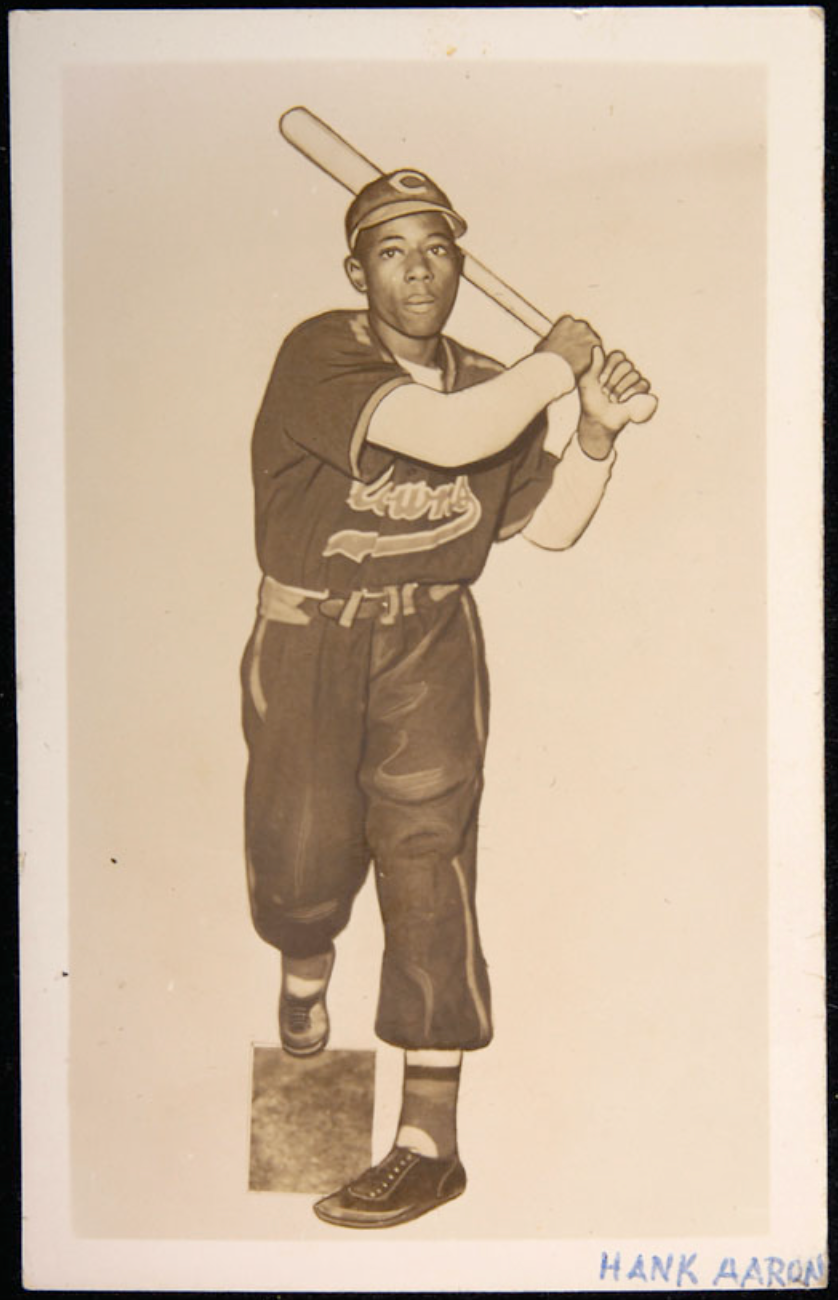
Of the postcards Pollock mentioned he had made, solely two are presently recognized. One got here from Pollock himself. Hunt Auctions offered the Pollock-family instance in 2008 with household provenance for $6,000 (23).
Determine 14. The second recognized 1952 J.J.Ok. Henry Aaron postcard, from the non-public assortment of Indianapolis Clowns proprietor Syd Pollock. Hunt Auctions offered the postcard in 2008 with Pollock-family provenance for $6,000.
The opposite survived with Ed Scott. That truth is tough to separate from the remainder of the story. Scott had managed Aaron with the Cell Black Bears, helped join him with Indianapolis, labored carefully with Aaron and his household, watched him depart Cell, corresponded with Pollock because the younger participant’s profession accelerated, after which saved the postcard together with the pictures and clippings that documented these months.
In November 2024, Scott’s postcard returned to public view at Hunt Auctions and offered for $199,750 (24). The value was extraordinary, however even on the time of the public sale, the postcard’s full significance remained largely unknown to the overall passion. To many collectors, it was merely a uncommon 1952 Henry Aaron postcard – an early pre-rookie situation that predated his 1954 Topps rookie card. However the surviving letters, newspaper appearances, scouting experiences, printing supplies and provenance present that it was way over that. The postcard was created through the transient window during which Aaron was nonetheless with the Indianapolis Clowns and Pollock was actively constructing his identify, selling him to MLB scouts and positioning him for a transfer into the major-league system. Collectors weren’t merely bidding on an previous image of Hank Aaron. They had been bidding on a surviving object from the second Hank Aaron was changing into Hank Aaron.
The pairing of the 2 recognized survivors is nearly poetic. One belonged to Ed Scott, the person who was with Aaron at first in Cell. The opposite belonged to Syd Pollock, the person who promoted him with the Clowns and negotiated his transfer into MLB. Pollock’s July 4 letter proves that extra copies as soon as existed: he despatched postcard images to Aaron and likewise mailed copies residence to Aaron’s father. How Ed Scott acquired the instance he preserved shouldn’t be documented. It might have been given to him instantly by Pollock or might have handed to him by Aaron’s household. What is for certain is that the 2 examples which have surfaced hint again to the 2 males on the heart of Aaron’s transition from the Indianapolis Clowns to the major-league system: Syd Pollock and Ed Scott.
No proof has been discovered that the J.J.Ok. postcard was commercially distributed like a traditional baseball-card situation. Its surviving provenance and Pollock’s personal phrases level as a substitute towards a small promotional and personal distribution. That restricted goal provides to its significance. This was not a card produced by Topps to promote bubble gum or fill out a guidelines. It was created for a particular purpose: to advance the profession of an 18-year-old Henry Aaron on the very starting of his skilled life. He was not included just because he occurred to play for the Indianapolis Clowns. The postcard seems to have been made as a result of folks round him already believed he had the potential to turn into one thing particular, even when nobody might have imagined simply how extraordinary his profession would turn into. That helps clarify each the cardboard’s historic significance and the way the earliest card of some of the collected gamers in baseball historical past might stay nearly invisible to the passion for thus lengthy.
The 1954 Topps #128 will at all times occupy its rightful place. It’s Aaron’s rookie card, issued throughout his first major-league season, and one of many nice items of postwar cardboard. However the historic report begins two years earlier. The 1952 J.J.Ok. postcard is the earliest Hank Aaron card.
Few playing cards from the Fifties provide collectors something resembling the trendy chase for a real one-of-one. For many classic points, shortage ultimately turns into a matter of situation rarity: the cardboard itself could also be extensively accessible, whereas the best grades sit on the prime of the amassing pyramid. The 1952 J.J.Ok. Henry Aaron postcard is completely different. With solely two presently recognized examples, it offers probably the most superior collector one thing far rarer – the chance to personal certainly one of solely two recognized surviving playing cards of one of many best gamers in baseball historical past, created on the very starting of his skilled profession. That type of rarity is nearly nonexistent for a participant of Aaron’s stature. The 1954 Topps rookie is iconic, commercially produced and central to the passion, however it was made in amount as a part of a nationwide set. The J.J.Ok. postcard was not. Its significance comes not solely from being earlier, however from being terribly scarce and from having been created for a particular goal tied on to the start of Aaron’s profession. For a severe collector, it affords the type of mountain-top purpose that classic amassing hardly ever offers.
The significance of the 1952 J.J.Ok. postcard shouldn’t be merely that it wins a race to an earlier date; it’s what the cardboard represents. It was made throughout Aaron’s transient 1952 season with the Indianapolis Clowns, whereas he was 18 years previous and being launched to the baseball world. Its picture could be tied to Pollock’s documented publicity marketing campaign. The identical art work survives in a museum print, a newspaper minimize, Scott’s clipping and 7 documented newspaper appearances. Pollock’s correspondence confirms the postcards had been made and distributed. And the 2 recognized examples carry direct provenance to Scott and Pollock.
Few baseball playing cards enable us to face this near the second they had been created. Often, collectors know the yr a card was issued however little in regards to the exact second of its creation. Right here, the encompassing historical past survives with it: the prepare images, the questionnaire, the letter asserting the publicity plan, the scout’s report, the contract negotiations, the printing minimize, the newspaper path and the letter that lastly says, in Pollock’s personal phrases, that he had postcard photographs made.
Aaron reached the main leagues in 1954 and spent 23 seasons constructing one of many best careers the sport has ever seen: 3,771 hits, 2,297 RBIs, 6,856 whole bases and 755 residence runs. In 1974 he handed Babe Ruth. In 1982 he entered the Nationwide Baseball Corridor of Fame on his first poll (25). When he retired in 1976, Aaron was the final commonly energetic major-league participant whose skilled profession had included the Negro Leagues, a dwelling bridge between two eras of baseball historical past (26).
In some ways, Jackie Robinson opened the door that Henry Aaron finally walked by. Robinson broke Main League Baseball’s coloration barrier and compelled the sport to confront the exclusion of Black gamers. A technology later, Aaron did one thing equally symbolic otherwise: he positioned a Black identify above Babe Ruth’s on the prime of baseball’s most celebrated report. He did so whereas enduring years of racism, threats and hatred that echoed the hostility Robinson had confronted when he entered the main leagues. Robinson proved that Black gamers belonged in Main League Baseball. Aaron, by the tip of his profession, had written his identify throughout the very prime of its report e-book.
All of that makes it tempting to have a look at the postcard and see the legend. However its energy comes from the other. The postcard reveals neither the Milwaukee Courageous nor the Atlanta icon. There isn’t any quantity 44. There isn’t any 715th residence run, no standing ovation, no Corridor of Fame plaque. There may be solely Henry Aaron, eighteen years previous, sporting an Indianapolis Clowns uniform at first.
The postcard was created to make the baseball world discover an unknown younger participant. Greater than seventy years later, it survives as one of many clearest data of the second the baseball world started to note Henry Aaron.
Notes
- Topps, 1954 Topps Baseball, card #128; PSA CardFacts, 1954 Topps Henry Aaron #128. The 1954 Topps #128 is Aaron’s rookie card.
- 1952 J.J.Ok. Henry Aaron postcard, Ed Scott instance, entrance and reverse. Reverse imprint: ‘J.J.Ok. Copy-Artwork Photographers, N.Y.C. 36.’
- George Bovenizer, Henry Aaron: Rising Up in Cell, Alabama, Society for American Baseball Analysis; Henry Aaron with Lonnie Wheeler, I Had a Hammer. Scott managed the Cell Black Bears and scouted for the Indianapolis Clowns.
- Henry Aaron, Indianapolis Clowns participant questionnaire, November 13, 1951, Syd Pollock assortment.
- Henry Aaron to Syd Pollock, March 24, 1952, Syd Pollock assortment.
- Charlotte Observer, April 17, 1952; The Name (Kansas Metropolis), April 25, 1952; Atlanta Each day World, April 26, 1952.
- Huntsville Mirror, Could 10, 1952, p. 7.
- Syd Pollock to Ed Scott, Could 10, 1952. Pollock wrote that he was getting ‘newspaper cuts and photographs made up’ on Aaron to attract scouts’ consideration and construct his identify nationally. The Negro American League common season opened Could 11.
- New Pittsburgh Courier, June 7, 1952, p. 16; The Name, June 6, 1952, p. 12. The printed statistics mirrored Aaron’s early league efficiency by Could 25.
- Dewey S. Griggs to John W. Mullen, Could 25, 1952.
- Dewey S. Griggs, Particular person Participant Report: Henry Aaron, Could 26, 1952. The report incorrectly lists Aaron as 17; he was 18.
- Syd Pollock to John W. Mullen, Could 27, 1952.
- Hunt Auctions, Syd Pollock archive, March 2008; up to date newspaper experiences together with Kansas Metropolis Instances, Could 31, 1952.
- J.J.Ok. Copy-Artwork Photographers was the photographic copy enterprise of James J. Kriegsmann in New York Metropolis. The Aaron determine itself is visibly a hand-rendered picture reproduced photographically.
- Herald-Press (St. Joseph, Michigan), June 6, 1952, p. 8.
- Chicago Defender, June 7, 1952, p. 29. Surviving Aaron newspaper printing minimize, Ed Scott assortment.
- Syd Pollock to Ed Scott, July 4, 1952. Pollock wrote: ‘I despatched Henry some put up card photographs I had made up of himself, additionally despatched some residence to his dad.’
- Bodily measurements by the creator: Aaron determine, foot to move – J.J.Ok. postcard 4 9/16 inches; surviving printing minimize 4 9/16 inches; newspaper copy 4 12/16 inches.
- Documented newspaper appearances: Herald-Press, June 6; Chicago Defender, June 7; The Expositor (Brantford), June 17; Atlanta Each day World, July 8; St. Louis American, August 7 and August 14; Johnson Metropolis Press, October 7, 1952.
- Chief-Telegram (Eau Claire), June 15, 1952. Up to date reporting establishes Aaron’s Eau Claire debut on June 14.
- Alan Cohen, ‘Henry Aaron and the 1952 Indianapolis Clowns,’ Society for American Baseball Analysis. Later June statistical reporting locations Aaron at roughly .374 with 5 residence runs and 32 RBIs over his preliminary Clowns regular-season stint.
- Instances-Picayune, September 26, 1952; Louisiana Weekly, September 27, 1952; Miami Instances, October 18, 1952.
- Hunt Auctions, March 2008, Lot 792, 1952 Hank Aaron actual photographic postcard, Pollock-family provenance. Sale value: $6,000.
- Related Press, November 17-18, 2024, reporting Hunt Auctions’ Louisville Slugger Museum & Manufacturing facility public sale. The Ed Scott postcard offered for $199,750.
- Nationwide Baseball Corridor of Fame, Henry Aaron profession and induction supplies. Aaron was elected in 1982 in his first yr of eligibility.
- Atlanta Journal-Structure, ‘Negro leagues opened door to gamers who would change baseball without end,’ February 13, 2020; SABR biography of Minnie Miñoso. Aaron was the final commonly energetic major-league participant whose skilled profession had included the Negro Leagues; Miñoso later made transient promotional appearances.
- Alan J. Pollock, Barnstorming to Heaven: Syd Pollock and His Nice Black Groups, ed. James A. Riley (Tuscaloosa: College of Alabama Press, 2006), 226-27. Pollock reproduces Ed Scott’s recollection of taking Aaron to the prepare station, photographing him earlier than departure and watching him wave from the prepare because it pulled away.
- Pollock, Barnstorming to Heaven, 224-26. Pollock identifies Bunny Downs because the Clowns’ enterprise supervisor and recounts Downs’s 1951 analysis of Aaron in Cell, together with a pregame tryout and favorable report back to Syd Pollock.
- Pollock, Barnstorming to Heaven, 229-30. Alan Pollock recounts Syd Pollock’s early direct effort to curiosity Braves govt John Mullen in Aaron, the unfavorable preliminary scouting report and Pollock’s insistence that Boston have Aaron re-scouted.
- Pollock, Barnstorming to Heaven, 230. Alan Pollock states that Aaron went seven-for-nine within the Could 25 Clowns-Memphis doubleheader watched by Braves scout Dewey Griggs.
- Pollock, Barnstorming to Heaven, 228, 230-31. Pollock recounts that Syd raised Aaron’s Clowns wage from $200 to $250 per thirty days after seeing him hit and later insisted that Boston pay Aaron $350 per thirty days.
- Pollock, Barnstorming to Heaven, 230-32. Pollock recounts the Giants’ Could 28 provide of $15,000 for Aaron’s contract and the competing negotiations that ended with Boston agreeing to the $10,000 transaction and a $350 month-to-month wage for Aaron.
- Syd Pollock to Ed Scott, July 4, 1952; Pollock, Barnstorming to Heaven, 224-25. Alan Pollock explains that Scott acquired a set fee when a participant he advisable was offered to an MLB group and that Aaron earned Scott $250, his largest fee from Syd Pollock.
Trending Merchandise