Creator’s notice: The 1909-11 American Tobacco Firm “White Borders” (T206) set has been no stranger to exhaustive research and analysis. Because of this, it might be that nothing I current right here is actually new. Nonetheless, I’ll name it “new to me,” and maybe new to lots of you. Definitely let me know within the Feedback if this actually has been coated earlier than.
Background
Whereas most collectors have some familiarity with the totally different T206 card backs, Piedmont and Candy Caporal being probably the most plentiful, the subject of “print groups” is extra usually reserved for the die-hards. Nonetheless, for collectors within the deeper construction and evolution of the T206 guidelines, print teams are usually not simply helpful however important.
In case you are not but acquainted with the T206 print teams, I encourage you to overview these pages from the wonderful T206 Resource web site.
Alternatively, you may merely consider the T206 set as one which got here out in waves quite than . Other than tiny particulars, you may view Print Teams 1-4 as sequential releases of 155, 200, 60, and 46 topics respectively and ignore the opposite two, at the very least for the needs of this text.
A Nearer Look
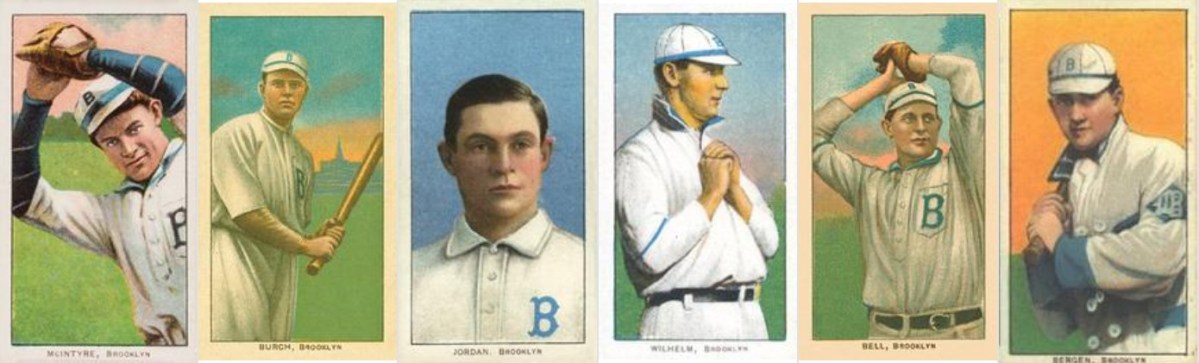
What I hope to do right here is characterize the second and third T206 print teams in a means that’s removed from a random Monster mash and may show helpful in understanding the set’s evolution. To maintain issues from getting too summary, I’ll begin with this association of the Brooklyn staff set, organized by print group.
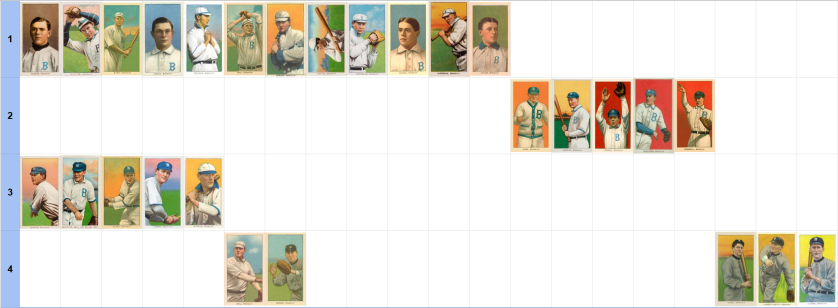
One factor to note concerning the Brooklyn staff set is that each one twelve of its Print Group 1 playing cards are of various gamers. Nevertheless, an analogous assertion can solely be made for half of the sixteen main league groups. As such, it might be mistaken to generalize from the Brooklyn’s Print Group 1 playing cards something too fascinating about all the set.
Alternatively, the second and third rows of the Brooklyn picture, equivalent to Print Teams 2 and three, actually do supply perception into the bigger set. Listed below are the important thing properties to note from the image.
- Print Group 2 provides new gamers however no new photographs of earlier gamers.
- Print Group 3 provides new photographs of earlier gamers however no new gamers.
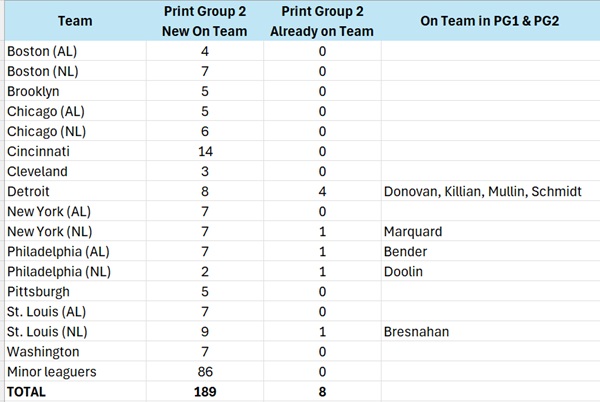
Whereas these characterizations of Print Teams 2 and three have exceptions throughout the bigger set, the exceptions are comparatively few. Focusing first on Print Group 2, there are 5 groups that break the “Brooklyn rule” and repeat gamers from the preliminary print group. Even then, nonetheless, all however one (Detroit) does so solely minimally.
Print Group 2 by Group
Shifting onto Print Group 3, regardless of the addition of 60 new topics there are solely 4 new gamers launched to the set: Frank Baker, Heinie Berger, Joe Doyle, and Jeff Sweeney.
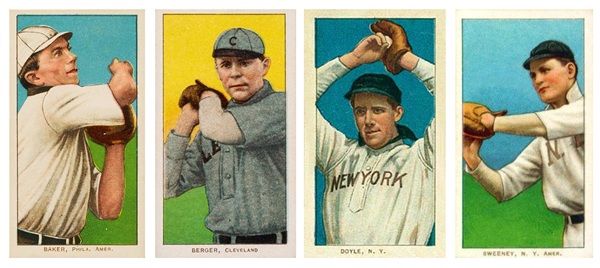
Everybody else on this print group is making (at the very least) their second look within the set.
Conclusions
Other than the so referred to as Super Prints (Print Group 5) and Southern Leaguers (Print Group 6), which I’m intentionally ignoring, the evolution of the Monster may most easily be understood on this method:
Following its preliminary batch of topics (Print Group 1), the principle technique for increasing the set was so as to add new gamers (Print Group 2). With that achieved, the following stage of progress (Print Group 3) primarily concerned including new playing cards of current gamers. The ultimate push (Print Group 4) did just a little of every.
As easy and helpful as this clarification appears, it’s not one I’ve run throughout so far in my studying on the set.

Trending Merchandise