Earlier than the Mariners there have been the Milwaukee Brewers and Seattle Pilots, the evanescing growth group from 1969. Lasting solely a single season, the Pilots flew off to Milwaukee throughout spring coaching beneath the brand new possession of a automotive salesman and future MLB commissioner Bud Selig after declaring chapter in April 1970. The MLB had rushed their growth plans and landed the Pilots in Seattle to play in a minor league stadium with plumbing points and a press field with blocked views beneath duress from a Missouri senator who had threatened the MLB’s coveted anti-trust exemption. The ensuing monetary stress on the homeowners and reticent Seattle taxpayers grounded the Pilots after their first season, which turned only a quick Seattle layover on their technique to Milwaukee.
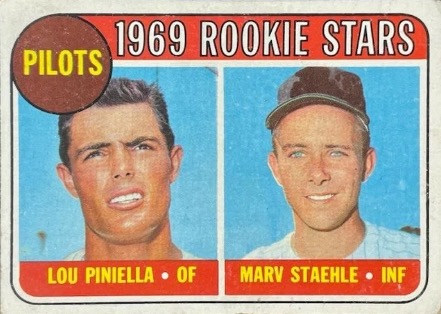
For group collectors, the MLB’s 1969 jaunt into Seattle gives a chance to personal a singular second in baseball historical past. Eminently collectible, the 1969 and 1970 Topps Pilots embrace notable playing cards resembling Lou Piniella’s third rookie card, a group card with its whole franchise historical past on the again, and your entire group roster that numbers within the mid-double digits.
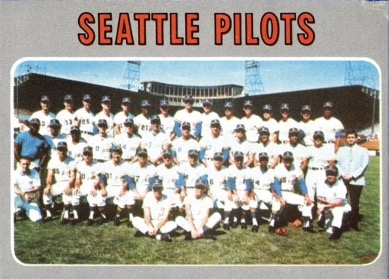
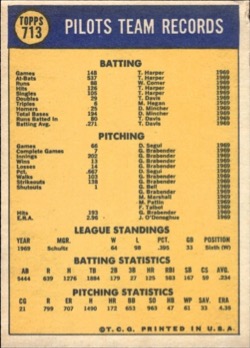
Seattle’s Sick’s Stadium within the background.
The reverse options the Pilots whole statistical
franchise history- in group colours.
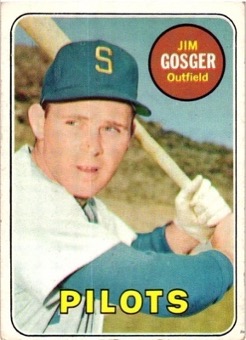
Among the many 26 1969 Topps Pilots playing cards, a lot of the situation options the Topps hallmark airbrushed logo-less caps, however Jim Gosger (#482) is the primary card to introduce the Pilots uniform and colours. Three of the Pilots, together with Gosger, had been issued with the yellow/white group identify variation- the others are Wealthy Rollins (#451) and Diego Segui (#511). The rarer white team-name variations command a 3.5x premium over the cardboard worth of the extra widespread yellow team-name situation.
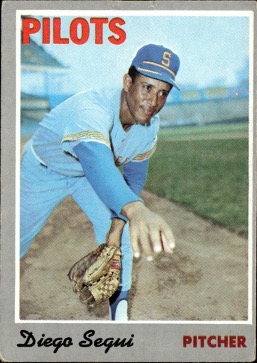
Cuban hurler Segui gives an fascinating view into Seattle’s future as he’s considered one of two Pilots that segued to the Mariners to complete their careers. Segui pitched each the primary video games for the Pilots and for the Mariners of their inaugural season in 1977. The opposite Pilot with a Seattle stop-over is Lou Piniella who’s pictured on his third “rookie card” #394. Piniella was additionally pictured on a Topps rookie card in 1968 for the Indians (#16) and in 1964 for the Washington Senators (#167), his true rookie card. Nevertheless, Piniella by no means truly performed for the Pilots since he was traded to the Kansas Metropolis Royals in spring coaching after the Topps print run. Piniella returned to Seattle and managed the Mariners from 1993-2002 and took the group to the postseason 4 occasions together with for his or her 116-win, 2001 season and received supervisor of the 12 months in 1995 and 2001.
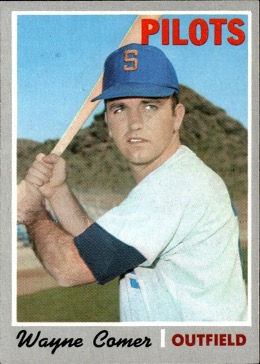
The 24 1970 Topps Pilots playing cards had been issued because the group was being renamed the Milwaukee Brewers. In actual fact, the Brewers blue and gold colours are a legacy of the transfer on the finish of the 1970 spring coaching in Tempe, Arizona when the tools vans with the Pilots uniforms enroute to Seattle had been instructed to divert east to Wisconsin as an alternative. Arriving inside days of Opening Day, there was no time for brand spanking new Brewers uniforms so the group simply adopted the Pilots colours and sewed “Brewers” on the jerseys in a easy block script.
Probably the most notable card of the 1970 sequence is the high-numbered Pilots group card (#713) which is the one one to characteristic Seattle’s Sick’s Stadium, the minor league venue that was pressured into MLB service earlier than it may very well be expanded and up to date and was the principle reason for the Pilots monetary misery with its uncovered seats with unhealthy views, and excessive ticket and concession costs. Sick’s Stadium was ignominiously demolished in 1979, a destiny which appears to be a recurring theme for Seattle sports activities venues. (See additionally the Dugdale Area arson 1932, the toppled UW Huskie Stadium 1987, and the imploded Kingdome 2000.) The one remnant remaining is a small signal and residential plate hidden within the muddle and carts on the entrance of a house enchancment retailer. The again of the Pilots’ group card summarizes its whole roster and statistical history- of their group colours. Photographs of the gamers playing cards had been taken both at spring coaching in Tempe, Arizona, with the Butte dominant within the background, or at Yankees Stadium in entrance of the grandstand.
Conspicuously absent from the 1969 and 1970 Topps Pilots playing cards is the cardboard for Jim Bouton. Bouton was fast-baller for the Yankees who received two video games within the 1964 World Sequence and developed a knuckleball as a reduction pitcher for the Pilots. Often known as “Bulldog” for his aggressive play, his contract was picked up by the Pilots earlier than the growth draft in 1968. He’s finest recognized nevertheless for his memoir Ball 4: My Life and Exhausting Instances Throwing the Knuckleball within the Huge Leagues through which he brazenly shares his unvarnished view from inside baseball based mostly on his diary from the 1968 and 1969 seasons. Bouton ought to have had a 1969 Topps card since he had joined the Pilots early of their tenure, and positively by 1970, but it surely has been urged that his involvement with the Gamers Union could have disenfranchised him with Topps. His guide, which was printed in 1970 and instantly denounced by commissioner Bowie Kuhn who tried to discredit the exposé, sealed the deal and his 1968 Yankees #562 could be his final Topps card.
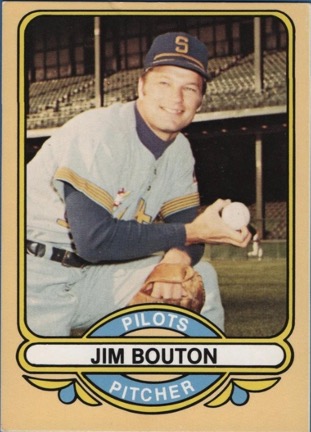
Different collectible and oddball sequence are the 1983 Renata Galasso set of your entire roster of 43 Pilots (together with Jim Bouton), the 1970 Kellogg’s 3-D Tremendous Stars which characteristic Tommy Harper #74 and Don Mincher #75, the 1969 Topps Deckle Fringe of Tommy Davis #15, and the 1969 Topps Tremendous playing cards of Tommy Davis #32 and Don Mincher #33.
Following the Pilots flight to Milwaukee, town of Seattle determined to play hardball with the American League and filed go well with for $32 million in damages for breach of contract as King County voters had already permitted a $40 million bond situation in 1968 for a brand new domed stadium as a situation of being awarded the Pilots. After years of failed negotiations, the trial lastly began in 1976 and resulted in an settlement by the League to supply an growth group for the 1977 season. The brand new $67 million domed multipurpose stadium, the Kingdome, was accomplished in 1976 in time for Opening Day for when the Mariners would lastly dock in Seattle.
Editor’s be aware: Pilots followers may additionally take pleasure in these two different SABR Baseball Playing cards articles:

Trending Merchandise