Hank Thompson isn’t remembered immediately like his fellow outfielders Wille Mays and Monte Irvin. And that’s a disgrace, as a result of his story is without doubt one of the extra fascinating, and saddest, from the Coloration Line period. He broke in with the Browns in July 1947, was let go earlier than the season ended, spent 1948 again with the Kansas Metropolis Monarchs, then signed with the Giants that winter. He debuted with the staff in July 1949, changing into the primary participant to combine two totally different major-league franchises. He had actual energy and endurance from the left aspect, and a gentle glove at third and later second. The great years didn’t final lengthy, although. Arm and knee hassle, and struggles off the sphere, caught up with him quick, and his profession ended nicely earlier than it ought to have. He died in 1969 at 43, having lived a tough life.
A profession that brief doesn’t depart a lot cardboard behind, which is why I finished chilly at a supplier’s desk on the Nationwide. I used to be looking tables when a inexperienced card caught my eye within the case. 1955 Robert Goulds are the sort of factor you could find in the event you look arduous sufficient, however you hardly ever see one in particular person, so I requested the supplier to tug it. That’s all I anticipated to occur.
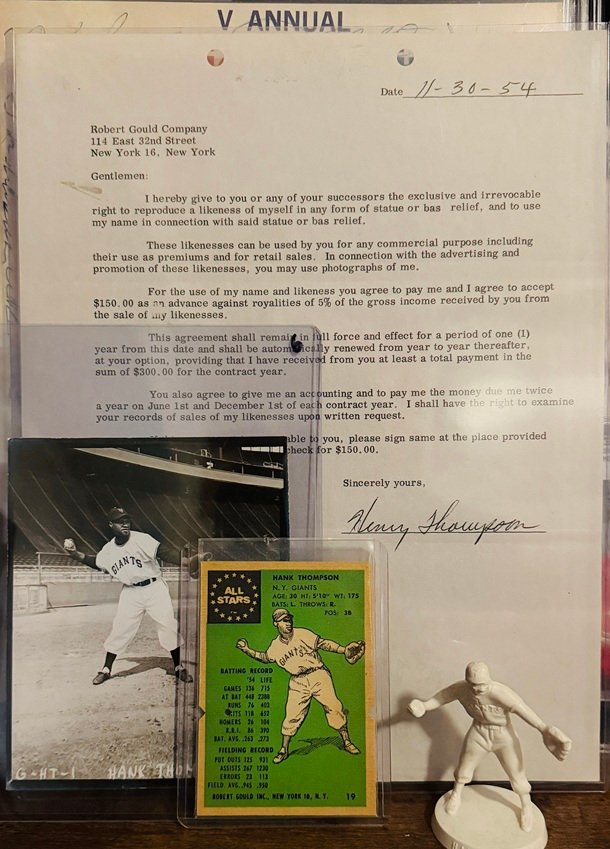
Then he reached again and set down the statue, exhibiting Thompson mid-throw in his Giants flannels, title molded into the bottom, an analogous pose to the picture on the cardboard. Then the photograph, a kind one taken on the Polo Grounds; the one used to create the cardboard and the statue. Lastly, the precise contract with Robert Gould, signed by Thompson on November 30, 1954, in change for 5 p.c of the product sales, with $150 as an advance. The signature was fascinating, too. He signed the contract “Henry Thompson”, whereas most of his autographs use his
“Hank” nickname. Henry appears to have been reserved for contracts and official paperwork, so a clear, absolutely written “Henry Thompson” like this one doesn’t flip up usually.
The cardboard and statue had been in uncooked, ungraded, situation, whereas the photograph and contract had been authenticated by PSA.
By some means all 4 of those distinctive gadgets had been assembled after greater than 70 years and ended up on a desk in Chicago. Now they sit on my desk!
Standing there with all 4 items in entrance of me, I discovered myself eager to know extra in regards to the set itself, and it turns on the market’s extra to it than I noticed. Gould bought the playing cards and figures via toy shops at $0.15 for a single determine, $0.29 for 2, or $1 for a field of seven with a bit “Details and Figures” booklet tucked inside. These costs had been considerably larger than the $0.01 and $0.05 Topps and Bowman packs, placing them out of attain of many children. The playing cards had been connected to the statues by rubber band, utilizing little notches on the edges of the playing cards, not precisely the very best system for preserving the playing cards in good situation.
There’s hypothesis that Gould deliberate a second sequence past the unique 28, nevertheless it by no means got here to fruition. The set didn’t catch on the way in which a number of the different oddball units from that period did both. It ended after one sequence whereas units like Hires Root Beer three years later, or the Put up cereal playing cards a couple of years after that, caught round lengthy sufficient to develop into accumulating staples in their very own proper. Which is unlucky, as a result of the Goulds had been distinctive playing cards, in contrast to anything being made on the time.
This distinctive “set” was an amazing addition to my rising Hank Thompson assortment. It seems to be nice sitting subsequent to my El Indio and Almanaque Deportivo Thompsons. He’s turning into one in all my favourite area of interest gamers to gather.
Editor’s Word: When you haven’t already learn the SABR Bio of Hank Thompson it’s undoubtedly price a learn.
Trending Merchandise